Austin compatibility standards after the 2024 reform: who they still apply to
Almost everything written about this before July 2024 is wrong now
Compatibility standards are the single most out-of-date topic in Austin land use commentary, and the reason is unusually clean. The editor's note to Article 10 records that Ordinance 20240516-004, effective 15 July 2024, repealed the former Article 10 in its entirety — §§25-2-1051, 25-2-1052, 25-2-1061 to 25-2-1068, 25-2-1081 and 25-2-1082 — and enacted a new article in its place.
Not amended. Replaced. Every section in the current article carries that one source line and no earlier ordinances behind it.
So the figures still in wide circulation — the long reach measured in hundreds of feet, the stepped height planes, the old triggering rules — describe law that no longer exists. If a summary you are reading does not mention July 2024, it is describing the repealed article.
The test has two sides, and both must be satisfied
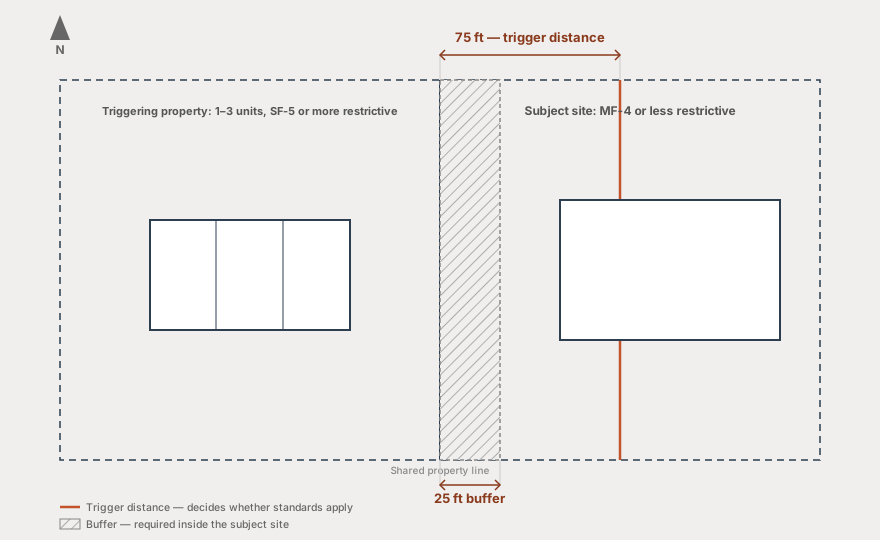
Compatibility only engages when a qualifying site is near a qualifying triggering property. Get either side wrong and you will reach the wrong answer.
Your site (§25-2-1051) must be:
- zoned MF-4 or less restrictive; and
- located within 75 feet of a triggering property.
The triggering property (§25-2-1053) must be a site:
- with at least one dwelling unit but fewer than four; and
- zoned SF-5 or more restrictive.
Two consequences worth drawing out. A large apartment building next door is not a triggering property — four or more units takes it out. And vacant land is not either, because a triggering property needs at least one dwelling unit on it.
| Distance from any part of a triggering property | Maximum height |
|---|---|
| Less than 50 ft | 40 ft |
| At least 50 ft but less than 75 ft | 60 ft |
| 75 ft or more | the site's own zoning limit |
§25-2-1061. Note §25-2-1061(A): "structure" means a portion of a structure — so the limits are measured part by part, and a building can step up as it moves away rather than being capped as a whole.
Buffers: 25 feet, with two real exemptions
§25-2-1062(B) requires a compatibility buffer along a property line shared with a triggering property. The minimum width is 25 feet, or 15 feet where the site is less than 75 feet wide measured from that shared line.
Two exemptions matter, and the first is significant for small infill multifamily:
- no buffer is required if the site includes only residential uses and 16 or fewer dwelling units; or
- no buffer is required if the site's zoning sets a maximum height of 40 feet or less and it is zoned NO, LO or LR.
§25-2-1062(A) also disapplies the whole section to condominium residential use and townhouse residential use.
What can go in a buffer is governed by §25-8-700: broadly, no vertical structures, though stormwater control measures and retaining walls are permitted.
Separately, §25-2-1062(C) sets setbacks along the shared line: a 10-foot rear yard for NO, LO and LR sites, and a five-foot interior side yard for LR.
Light, noise, bins and screening
§25-2-1063 handles the day-to-day friction, all measured at the property line or alleyway shared with the triggering property:
- Lighting must be hooded or shielded so the light source is not visible from that line.
- Mechanical equipment may not produce sound above 70 decibels measured there.
- A concrete slab for a refuse receptacle may not sit within 15 feet of a triggering property.
- An on-site amenity for residents and their guests may not be within 25 feet of one — except a multi-use trail.
And a screening list: vehicle lights from parking on the site, ground floor and rooftop mechanical equipment, outdoor storage, refuse receptacles and collection areas, and common amenity areas including decks, patios and pools must all be screened from that shared line. Rooftop equipment may be screened by a parapet, and screening may not impede pedestrian or bicycle access points.
Site-specific amendments are rezonings
§25-2-1054 lets council grant site-specific amendments to the height limits and compatibility buffers where it determines the amendment is appropriate and will not harm the surrounding area.
Two things to understand about that route. It is treated as a rezoning — same requirements and procedures as changing a base district classification, so it is not an administrative adjustment. And some sites are simply not eligible: those zoned a special purpose base district or a density bonus (DB) combining district, and any site subject to the university neighborhood overlay.
Where this actually comes up for us
On our own projects it comes up whenever we build four or more units, because a site zoned MF-4 or less restrictive is exactly what Article 10 reaches. Houses, duplexes and two- and three-unit builds are excluded by name, so it never reaches those. When clients raise it, they have usually read something written before the 2024 reform and are worried about a rule that no longer applies to them.
Where it does come up is the other direction: a client's SF-3 lot is the triggering property for someone else's project next door. Knowing that a neighboring building must drop to 40 feet within 50 feet of the shared line, and that bins, lighting and mechanical plant are regulated at that line, is worth having in a conversation about what may be built alongside you.
The four-unit threshold in §25-2-1053 is the detail people miss. If your lot already has four or more units on it, it is not a triggering property and none of this protects it.
Common questions
Send us an address and we will tell you what we find
We do this research ourselves on every project we take on — zoning, floodplain, watershed, trees, whether it is a legal lot. Send us an address and we will run it and tell you what we find. It works the same whether you own a vacant lot, a house you are thinking of adding a unit to, or a house you are thinking of replacing. No charge and no strings, and if it is a bad lot we will say so.
Send us an addressWe are homebuilders, not the City of Austin. This page explains how we read the code in practice — it is not legal advice and it is not an official determination. Always confirm with Austin Development Services before you rely on it for a project. The authoritative text is the Austin Land Development Code; permitting questions go to Austin Development Services Department.